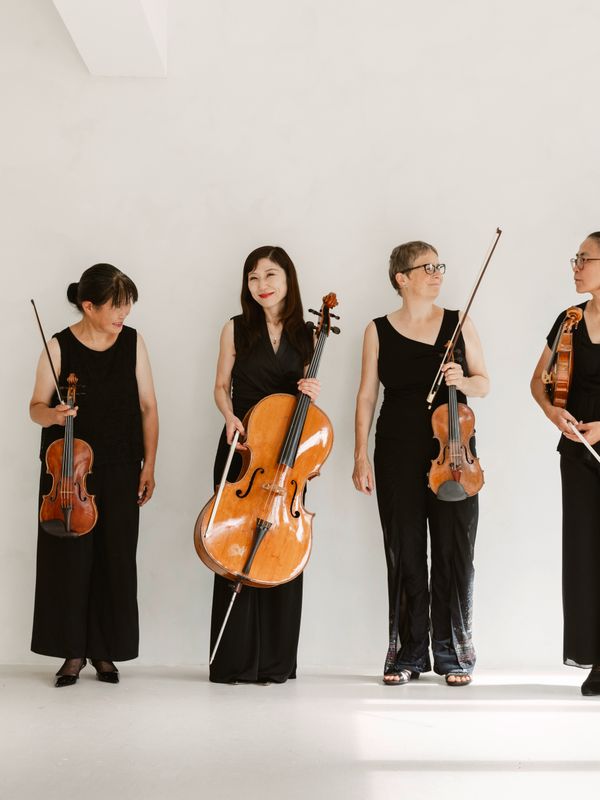
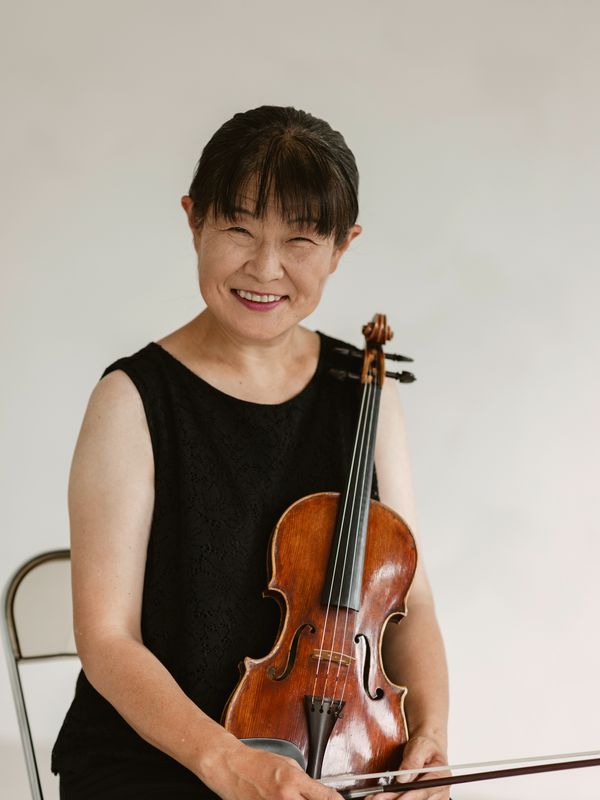
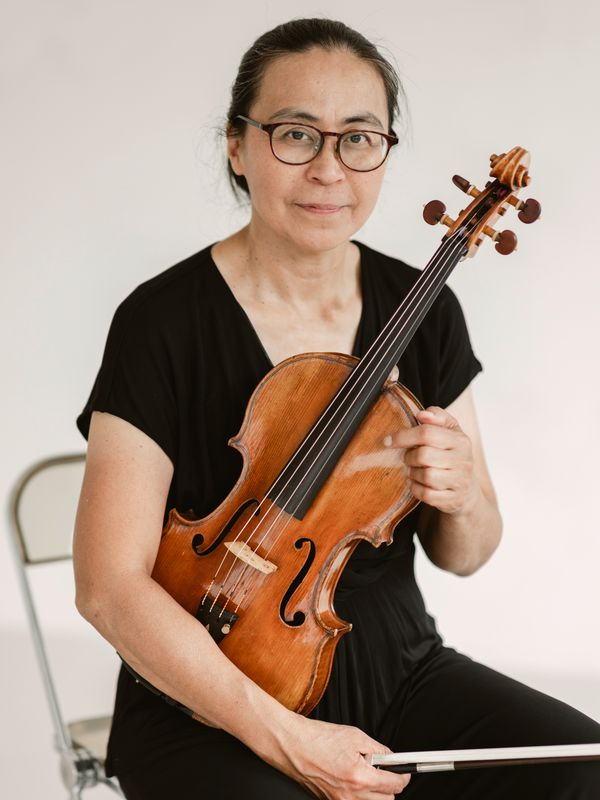
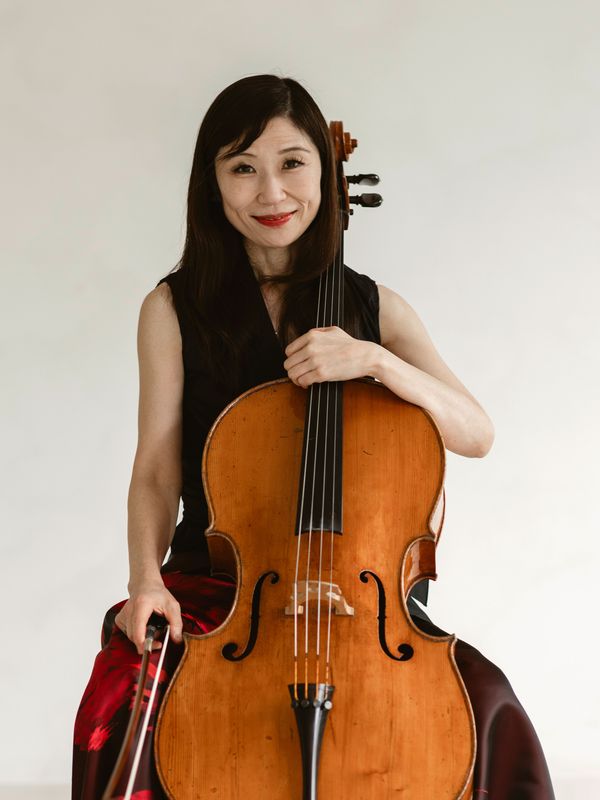
Founded in Tokyo in 1992 and based in Stuttgart for many years, the Lotus Quartet is one of the few all-female string quartets to have performed for decades at the highest level with virtually unchanged membership. The ensemble’s distinctive spirit—marked by a synthesis of cultural influences from Japan and Germany—will now receive fresh inspiration: beginning with the 2025/26 season, Christine Busch will join the quartet.
The Stuttgart-based violinist and professor has distinguished herself above all in the field of historically informed performance, with highly acclaimed recordings to her credit, including the Sonatas and Partitas of Johann Sebastian Bach. Alongside her work as concertmaster with renowned international ensembles, Busch has also been deeply dedicated to quartet playing. Since the new formation, Sachiko Kobayashi and Christine Busch will alternate in the two violin parts.
The first major project in this new constellation was a Japan tour in March 2026, featuring the three string quartets by Johannes Brahms as well as works by Mozart, Schubert, and Webern.
Founded in Tokyo in 1992 and based in Stuttgart for many years, the Lotus Quartet is one of the few all-female string quartets that has performed at the highest level for decades with an almost unchanged lineup. The ensemble’s distinctive artistic identity—shaped by a synthesis of Japanese and German cultural influences—is now gaining new momentum: beginning with the 2025/26 season, Christine Busch will join the quartet. A violinist and professor in Stuttgart, she has distinguished herself particularly in the field of historically informed performance practice. She has released highly acclaimed recordings, including an interpretation of the Sonatas and Partitas by Johann Sebastian Bach. Alongside her work as concertmaster with leading international orchestras, Busch has devoted herself intensively to chamber music, especially quartet playing. In the new formation, Sachiko Kobayashi and Christine Busch will alternate in the two violin parts. The first major project in this constellation will be a tour of Japan in March 2026, featuring the three string quartets by Johannes Brahms as well as works by Mozart, Schubert, and Webern.
The string quartets of the Viennese Classical period and German Romanticism, along with French Impressionism, form the core of the Lotus Quartet’s repertoire. In addition, contemporary Japanese composers such as Tōru Takemitsu and Toshio Hosokawa play an important role. Modern repertoire is represented in particular by Helmut Lachenmann and the Second Viennese School. Special attention has been drawn to recordings of selected Mozart quartets and a production featuring contemporary Japanese composers (released by Teldec in 1997 and 2000), as well as a CD of lesser-known quartets by the Bohemian composer Johann Baptist Vanhal (cpo, 2014). The excellent reviews from critics challenged a once widespread prejudice that Asian musicians lacked an authentic understanding of the intellectual world of the European repertoire.
As early as 1993, the Lotus Quartet won third prize at the prestigious International Chamber Music Competition in Osaka. A scholarship enabled the four musicians to participate in masterclasses with the Amadeus Quartet and the Melos Quartet. From 1995 onwards, they studied with the Melos Quartet at the State University of Music and Performing Arts Stuttgart. Competition successes soon followed: second prize at the Viotti Competition in Italy (1995), the Menuhin Prize at the London International String Quartet Competition (1996/97), third prize at the renowned “Premio Paolo Borciani,” and first prize at the competition of the Kulturkreis der Deutschen Wirtschaft.
Within a short time, the Lotus Quartet established itself as a welcome guest in major German chamber music series in cities such as Munich, Erfurt, Bruchsal, and Braunschweig, as well as at summer festivals including the Mecklenburg-Vorpommern Festival and the Schleswig-Holstein Music Festival, where the ensemble worked intensively in 1998 with Walter Levin, former first violinist of the LaSalle Quartet. This period also marked the beginning of the quartet’s international career, with performances in Valencia, Zurich, Tokyo, Osaka, and beyond.
In addition to regular appearances at major German venues such as the Konzerthaus Berlin, Laeiszhalle Hamburg, Tonhalle Düsseldorf, and Stuttgart’s Liederhalle, as well as at leading festivals, the Lotus Quartet has performed successfully across Europe. The ensemble tours regularly in its home country Japan, appearing in all major cultural centers. Since 1998, it has performed annually in Darmstadt, where it presented the complete string quartets of Beethoven. In November 2004, it began a Schubert cycle, followed from 2008 by a five-concert series featuring Mozart’s ten mature string quartets and his five string quintets. In 2012, the ensemble celebrated its 20th anniversary with a concert at Izumi Hall in Osaka, recorded by Japanese television (NHK). In 2017, the quartet performed another Beethoven cycle in Japan, followed in 2018 by performances of Beethoven’s late quartets in several Japanese cities.
Cyclical performances of the quartets by major composers such as Mozart, Schubert, Schumann, Brahms, and Beethoven play a central role in the ensemble’s regular tours of Japan. The tour marking the quartet’s 30th anniversary in February 2023 included performances of all six string quartets by Felix Mendelssohn across two evenings.
Chamber music partners of the Lotus Quartet have included Wolfgang Boettcher, Martin Fröst, Sebastian Manz, Peter Buck, Wolfgang Güttler, Philippe Tondre, and Bernd Glemser.